
How Much Will a Card Dealer Pay for Your Cards? How an Offer Is Built
A card dealer will pay less than your cards recently sold for: a small gap on cards that sell every week, a wide one on cards that sell twice a year, and bulk priced by the box. Sports Illustrated's collectibles site wrote in July 2025 that most local card shops will not go above 60 to 70 percent when buying from customers. The ceiling behind every offer is simple arithmetic: on a card that sells for $1,000, eBay's fees leave a reseller about $867 to $876, so a dealer who resells there cannot pay much more than 87 percent and break even, before shipping, returns, time, and margin.
We buy cards from collectors and resell them, so this is the math behind every offer we make, whether it covers one slab or a whole collection. Here is how an offer gets built, and how to judge any offer you receive, ours included.
Start from the right number
Every fair offer starts from what the card has actually sold for recently, in the same grade or condition. Not what it is listed for, and not the best sale in its history.
- Sold, not listed. Active listings show what sellers hope for. Completed sales show what buyers paid.
- Same card, same grade. A different parallel, a PSA 9 instead of a 10, or a raw copy with soft corners is a different card for pricing.
- Recent and repeated. Five sales in the last month tell you more than one sale from last spring.
- Estimates are not bids. Tools like Card Ladder publish a value built from the last sale and the player's overall market. It is a useful reference. It is not what anyone has agreed to pay.
If you are still working out what your cards sell for, start with our guide to finding what a card is worth.
What comes off the top before anyone earns a dollar
Say a PSA 10 sells for about $1,000, reliably, every week. If a dealer buys it and resells it on eBay, the first costs are fixed:
| On a $1,000 eBay sale | Standard rate | Basic store or higher |
|---|---|---|
| Final value fee | $132.50 | $123.50 |
| Per-order fee | $0.40 | $0.40 |
| Left over, before anything else | About $867 | About $876 |
eBay charges 13.25% at its standard rate, which also applies to its Starter store, and 12.35% with a Basic or higher store. It figures the fee on the total the buyer pays, including shipping and sales tax, so the real fee runs a little higher. The ceiling rises on pricier cards: at $5,000, a Basic or higher store keeps about $4,632, roughly 93 percent, because its rate drops to 2.35% above $2,500, while the standard rate stays near 87 percent up to $7,500. Whatever is left over is the most a dealer who resells on eBay could pay you and break even, and it comes before any of these:
- Shipping and supplies. Insured, tracked, signature shipping on a valuable card costs real money, and the buyer's shipping charge rarely covers all of it.
- Returns and claims. Buyers return cards, dispute condition, or report that a package never arrived. We offer returns on the cards we sell, so every sale carries some chance of coming back.
- Price risk. Between the day a dealer pays you and the day the card sells, the market can move. A player gets hurt, a prospect cools off, a new release pulls buyers away.
- Time and capital. The money paid for your card is tied up until it sells. On a card that sells in days, that costs little. On a card that sits for months, it costs a lot.
- The work. Listing, answering buyers, packing, and shipping, card after card.
- A margin. A dealer who never earns one will not be around the next time you want to sell.
The same costs apply to you if you sell the card yourself. That $867 to $876 is also roughly your own ceiling on eBay, before your time and before any return. So the honest comparison is never a dealer's offer against the card's sale price. It is a dealer's offer against what you would actually keep. Our guide to where to sell sports cards runs that comparison for eBay, PSA, auctions, and card shows.
Liquidity decides how big the gap is
The distance between the sales record and the offer is not a fixed percentage. It depends on how fast, and how predictably, a card turns back into cash.
| The card | How far below its sales record offers land |
|---|---|
| PSA 10s of established stars and key rookies that sell every week | Closest: many buyers, tight prices, sells in days |
| Strong PSA 9s and popular parallels | Moderate: steady demand, wider price swings |
| Prospect autographs and hyped rookies | Wider: prices move with every call-up and box score |
| Low-numbered parallels and one-of-ones | Card by card: few sales, and each one sets the price |
| Niche players | Wide: few buyers, and slow to resell |
| Raw cards that might grade well | Wide: the grade is a guess until it comes back |
| Vintage stars in high grades | Card by card: scarce copies, serious buyers |
| Base cards and commons | By the box, not by the card |
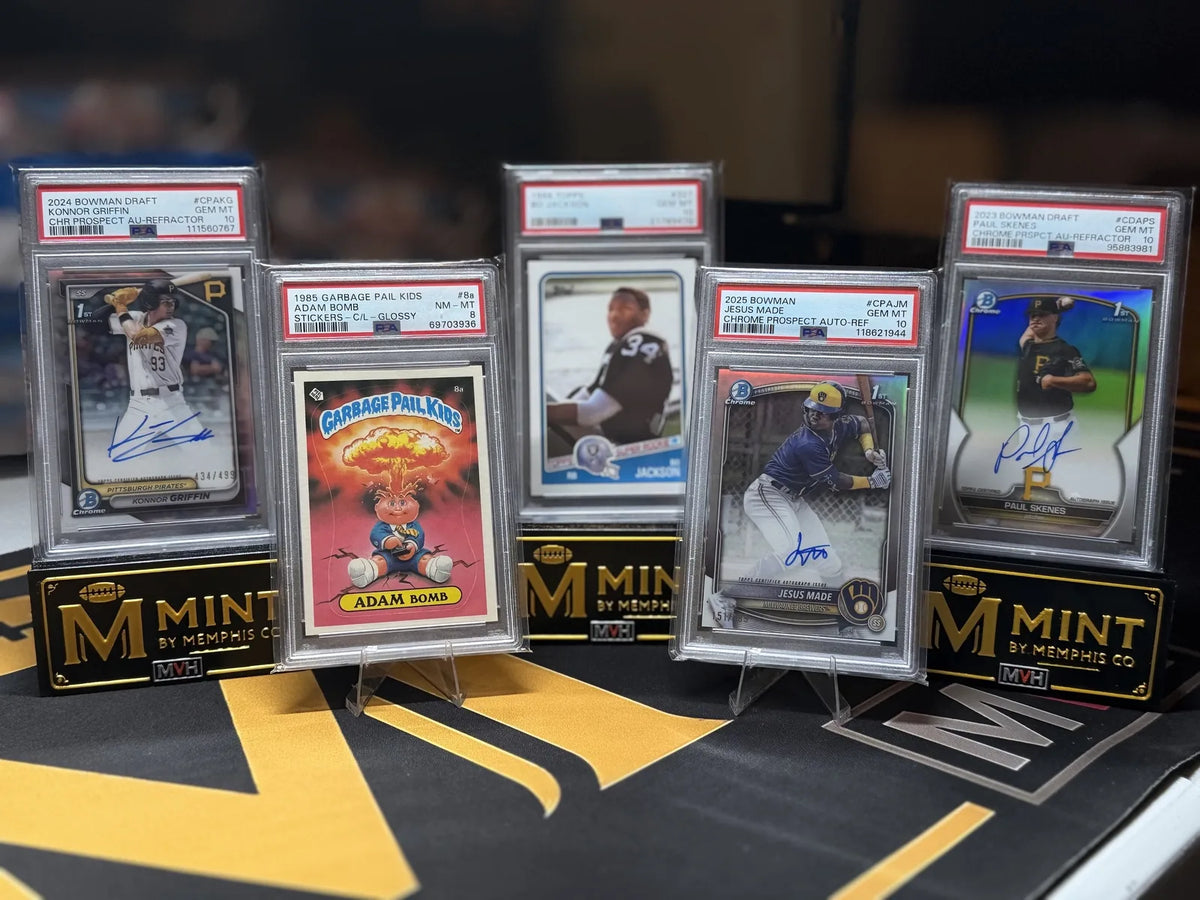
Five slabs from one recent intake: a Paul Skenes Bowman Draft Chrome autograph, two prospect autographs, a 1988 Topps Bo Jackson rookie, and a Garbage Pail Kids card. Same box, five different kinds of buyer.
That is why a buyer whose offer lands near the eBay net on a PSA 10 that sells every week may offer a much smaller share of the sales record on a /25 parallel of a backup quarterback. Neither offer is a trick. They reflect how differently the two cards resell.
Card shops, card shows, and mail-in buyers
The math is the same everywhere; the overhead is not. A local shop carries rent and staff and buys for its own display case. A show dealer pays for a table and travel and wants cards that will sell at the next show. A mail-in buyer like us pays for insured shipping both ways and recorded verification, and resells online. All of them price hot cards close and slow cards far, and all of them pay more for cards their own customers want.
Why a whole collection gets a different kind of offer
In most collections, most of the value sits in a small share of the cards: the slabs, the rookies of stars, the autographs, the numbered cards, and the vintage Hall of Famers. A good offer prices those cards one at a time and prices the rest by the box. If a buyer gives you one number for everything, ask how much of it comes from the key cards. A buyer who priced them individually can answer that in a minute.
Selling everything together has real advantages: one transaction, one shipment, no leftovers to list. It only works in your favor if the key cards were priced like key cards. If the cards came to you from someone else, see our guide to selling an inherited card collection.
Ready to sell? Send photos of what you have and get your offer, with the key cards priced one by one.
How to tell a fair offer from a lowball
Signs of a fair offer:
- The buyer can show you the recent sales behind the number, and tells you when the record is thin.
- Your key cards are priced individually.
- You get an actual number, in writing, before anything ships.
- The buyer pays for insured, tracked shipping and documents what arrives.
- If you decline, your cards come back to you, insured, at no cost.
Signs to slow down:
- One flat percentage for every card, whatever the card is.
- A "range" before you ship, then a lower number once the cards arrive, with no clear reason.
- Pressure to decide within the hour.
- No way to confirm who the buyer is.
If an offer comes in low, ask which cards carry the number and which sales the buyer used for them. If the gap sits in one or two key cards, sell those separately and take an offer on the rest. If the buyer cannot explain the number, walk away.
Instant offers are built the same way. A PSA Offer, for example, is a partner dealer's bid, worked out from the same fees and risks and delivered faster. A second offer is always reasonable to ask for; compare the two card by card on your key cards, not just the totals.
Cash or store credit
Many shops offer more in store credit than in cash, because credit is spent on inventory that cost them less than its sticker price. That can be a good deal if you were going to spend the money there anyway. With us, credit is simply the cash offer, dollar for dollar, as Vault Credit if you prefer it. It is the same number, never a bonus.
The offer, in four steps
- You send phone photos of what you have. You do not need to know sets, players, or values.
- We price every card that carries value one at a time, against recent sales of that exact card in that exact grade or condition, whether you send one slab or a whole collection.
- If there is a remainder, we price it as a group, and we tell you plainly when cards have little resale value.
- You get an actual, itemized offer before you ship, usually within 48 hours, with no obligation, and we explain how we got there.
If you accept, your cards ship on our prepaid, insured label and are verified on camera when they arrive. If they match your submission, the accepted offer is what you are paid, once they are verified; if something is materially different, we contact you before any adjustment, and if you decline, your cards come back free and insured. How selling to us works has every step.
How we actually review a submission
This is the part of the process most buyers keep to themselves. Ours is simple enough to print.
- Every card is identified on its own. Set, card number, parallel, serial number, and for a slab the grading company, the grade and the certification number. Nothing is priced as "a lot of cards". If a photo is not clear enough to identify a card, we ask for another photo before we price it.
- Each card is checked against recorded sales, not asking prices. Recent completed sales of that exact card in that exact grade. Where the record is thin, we say so on the offer line rather than pretend it is not.
- The offer is itemized. You see a line and a price for every card we want to buy, so you can remove any card and keep it, and the number for the rest does not change.
- We tell you what we will not buy, and why. Commons and bulk from the late 1980s and early 1990s, damaged cards, and cards that do not resell get an honest "not for us" and a note on where they belong. We do not pay a token amount to take them away.
- You get the number before anything ships, usually within 48 hours. It is an actual offer, not a range, and it holds if what arrives matches what you sent.
- On a completed purchase you receive the Collection Report. A written record of what was received, how each card was identified, and the basis for the number. It is a record for your file, not an appraisal.
Nothing in that list requires you to know cards. It requires you to send photos and read a list.
Common questions
What percentage of value do card dealers pay?
There is no single percentage, but there is a ceiling. On a card that sells for $1,000 on eBay, fees leave a reseller about $867 to $876, so a dealer who resells there cannot pay much more than 87 percent and break even, before shipping, returns, time, and margin. Offers land closest to that ceiling on cards that sell every week and furthest from it on slow, thinly traded, or condition-sensitive cards. Sports Illustrated's collectibles site wrote in July 2025 that most local card shops will not go above 60 to 70 percent.
Why is a dealer's offer lower than the Card Ladder value?
A Card Ladder value estimates what a card sells for on the open market. A dealer's offer is what the dealer can pay after the fees, risk, and time it takes to get that price. On a $1,000 card sold on eBay, the fees alone are about $124 to $133.
Do you buy the whole collection or just the best cards?
We make an offer on the cards we can resell, priced one at a time. If the rest has little value we say so and tell you where it belongs, rather than paying a token amount to take it away. You decide whether to sell the keys alone or everything we offered on.
What happens to the cards you do not want?
They stay with you. Our offer lists exactly what it covers; anything not on the list is yours to keep, sell elsewhere, or send to a bulk buyer. If you ship us something that is not on the list, it comes back to you insured at our cost.
Why is your offer a single number and not a range?
Because a range is not an offer. A range before you ship and a lower number once the cards arrive is the pattern that costs sellers money. Our number is written, itemized, and sent before anything ships; it holds if what arrives matches your submission, and if something is materially different we contact you before any adjustment.
Do dealers pay more for graded cards?
Usually a higher share of the sales record, because the grade removes the biggest unknown. Whether a card was worth grading before you sell it is a separate question, and our guide to grading before you sell walks through it. If you are selling slabs, see where to sell PSA graded cards.
See the Number, and the Reasoning
Send phone photos of what you have. You get an actual, itemized offer before anything ships, usually within 48 hours, and we explain how we got there. No obligation.