
Where to Sell PSA Graded Cards: PSA Offers, eBay, Auction, or a Dealer
You can sell a PSA slab five ways: a PSA Offer, if a partner dealer makes one; PSA's own eBay consignment; your own eBay listing; an auction house; or a dealer. Sell it where it nets the most after fees, waiting, and risk, not where the headline price looks biggest.
For most slabs, that means comparing four numbers: what you would keep on eBay, what PSA's consignment would leave you, your PSA Offer if one exists, and a dealer's offer. A trophy card with deep demand and no deadline also deserves a look at a major auction.
We buy PSA slabs from collectors and sell them on eBay and on our own site, so these fees come out of our pocket too.
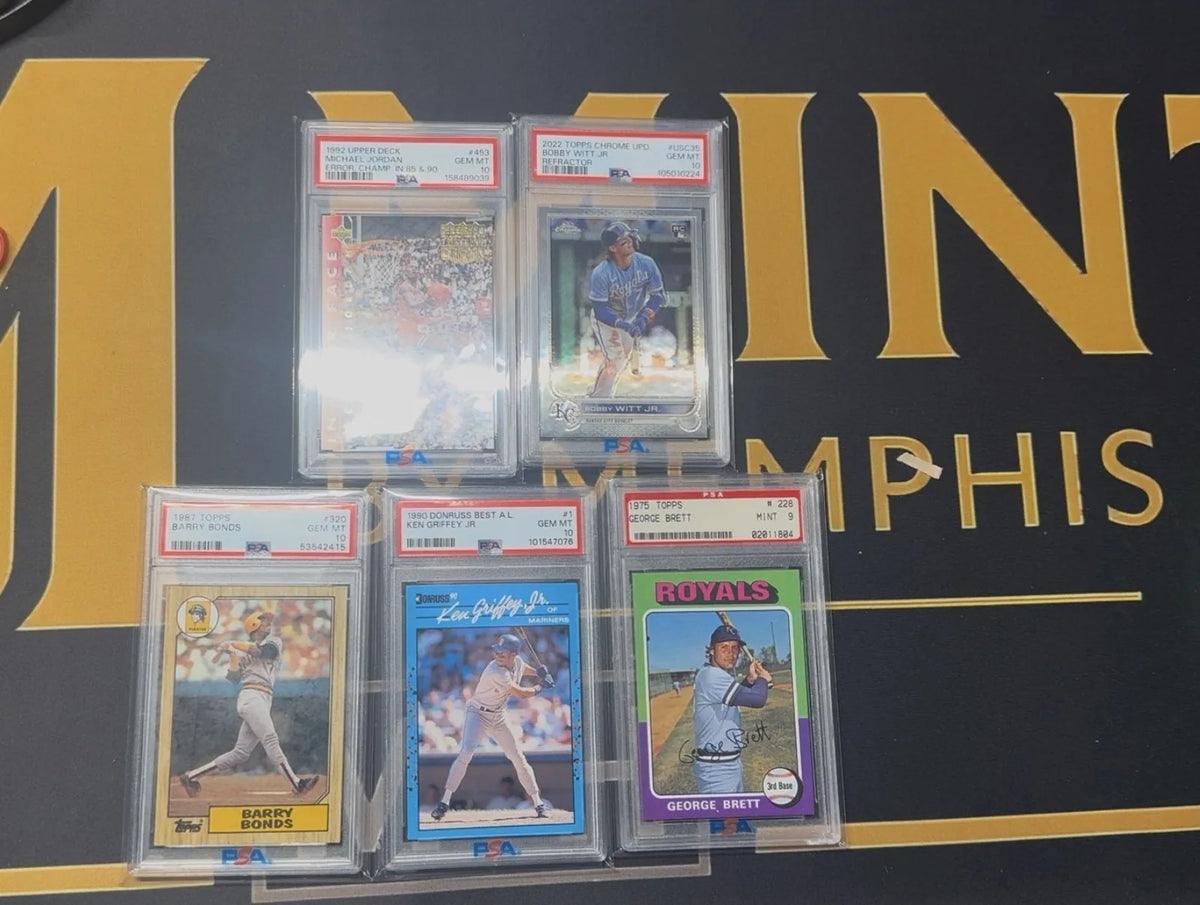
Five slabs from a recent purchase: four PSA 10s and a 1975 Topps George Brett rookie in PSA 9.
Start with the right number
Before you compare routes, pin down what this exact card, in this exact grade, has recently sold for. Use completed sales, not asking prices, and never price a PSA 9 off a PSA 10's sales. A Card Ladder value is a useful starting point, but it is an estimate, not a bid. Our guide to finding what a card is worth walks through it.
Your five options, and what each one costs
Fees and terms below are as each company published them in September 2026. They change, so check the current schedule before you commit.
PSA Offers
PSA shows cash offers from its partner network, dealers such as Dave & Adam's, Burbank Sportscards, CardsHQ, and Fanatics, on some cards at the grade-reveal stage and on cards stored in the PSA Vault.
- Cost: no selling fee. The offer you see is the offer you get, though your original grading and shipping fees still apply.
- Speed: payment starts when you accept, and PSA says it arrives in 1 to 3 business days.
- The catch: an offer only appears when a partner wants that card, it can change or expire without notice, and an accepted sale is final. At grade reveal you have 24 hours to decide. The card has to be in PSA's system, so a slab in your safe has to ship to the vault first.
PSA consignment on eBay
- Cost: one fee to PSA that covers eBay's cut: 13% plus $3 under $100, 13% up to $499, 12% from $500, 10% from $1,000, 9% from $2,500, and 7% at $5,000 and up.
- Speed: you choose a 7-day auction or Buy It Now. Auction winners have 7 days to pay, and PSA says the money reaches your bank account within a week after that.
- The catch: the card has to be at PSA, consigned at grade reveal or from the PSA Vault. Storing a slab in the vault is free, but one at home has to be shipped in, insured, before it can be listed, and taking it back out later costs a shipping fee plus a per-item withdrawal fee. PSA runs the listing, and a 7-day auction sells for whatever the market pays that week.
PSA charges its fee on the sale price alone, and from $100 to about $17,500 its fee is lower than eBay's at the standard rate. Against the lower rate for a Basic or higher eBay Store, PSA is cheaper on most cards between $500 and a few thousand dollars; on the most expensive cards the store rate wins, because eBay drops to 2.35% on everything above $2,500. If your card is liquid and already at PSA, consignment is a strong option, and we would tell you so.
If your card is still raw, you may come across PSA's Grade & Sell. It ran as a limited-time special for orders placed by September 30, 2025, and it is not among the ways to sell that PSA lists today. Under those terms PSA graded the card at a discount, then sold it through a PSA Offer at grade reveal or a 7-day eBay auction starting at $0.99, with no say over the timing or the starting price, and every card had to be sold whatever grade it got. If it returns, it suits a card you want gone no matter what. It is a poor fit for a card whose value depends on getting a 10.
Listing it yourself on eBay
- Cost: at eBay's standard rate, 13.25% of the sale up to $7,500 and 2.35% above that; sellers with a Starter store pay the same. With a Basic or higher eBay Store, 12.35% up to $2,500 and 2.35% above. Either way, add $0.40 per order over $10. eBay figures its fee on the total the buyer pays, including shipping and sales tax, so it bites a little harder than the headline rate.
- Speed: as fast as the card sells, plus eBay's payout timing.
- The catch: the photos, the listing, the buyer's questions, the packing, and any return or claim are all yours. A card that sells for $200 or more also goes to PSA for eBay's authentication check before it reaches the buyer, which protects both sides but adds time to delivery (eBay currently warns that some of these orders are delayed a week or more).
Auction houses
The big names for graded cards include Goldin, Heritage, and Fanatics Collect.
- Cost: the buyer pays a premium, commonly around 20% on top of the hammer price. Seller terms vary: Fanatics Collect currently charges no seller fee on graded cards in its Weekly and Premier auctions and pays the seller a bonus on top of the hammer price that rises with the price (2% from $50, 4% from $100, 6% from $1,000, 8% from $5,000, 10% from $10,000, and more above $250,000). Other houses set their own seller terms, so get them in writing before you consign.
- Speed: weeks to months, depending on the auction calendar and when the winner pays.
- The catch: serious bidders do the math on the premium, so part of it comes out of your hammer price whether the invoice says so or not. An auction earns its keep when many deep-pocketed buyers want the same card. It adds little for a card that already sells every week on eBay.
Selling to a dealer
- Cost: no fee. The dealer's costs and margin are built into the offer. That covers card shops, show dealers, mail-in buyers like us, and retail trade-in counters such as GameStop's graded card program.
- Speed: a shop or show dealer pays on the spot; a mail-in buyer like us pays once your card arrives and is verified.
- The catch: the offer will be below the card's recent sales, and how far below depends on the dealer and on how easily the card resells.
What each route nets on the same slab
The math on two example slabs, using the published fees above. The sale prices are illustrations, not quotes on any particular card.
| Route | $1,000 slab | $5,000 slab |
|---|---|---|
| eBay, standard rate | About $867* | About $4,337* |
| eBay, Basic store or higher | About $876* | About $4,632* |
| PSA consignment | $900 | $4,650 |
| PSA Offer | The offer, if one appears | The offer, if one appears |
| Auction house | The hammer price** | The hammer price** |
| Dealer | The offer | The offer |
*Before your shipping costs, and a little less once eBay counts the buyer's shipping and sales tax in its fee. The PSA consignment figures assume the slab is already at PSA. **Plus Fanatics Collect's seller bonus, 4% to 8% at these prices, or less any seller's commission a house charges. Bidders allow for the buyer's premium, which holds the hammer price down.
On a liquid card, a dealer's offer will usually land below what eBay or PSA's consignment would leave you. What a dealer gives you in exchange is certainty: one fixed number before the card ships, no listing, no auction that closes on a slow night, no return window, and no waiting on a buyer to pay. How much that is worth depends on the card and on you.
Are PSA Partner Offers worth it?
Often, yes. A partner offer is a dealer's bid, built from the same sales record and the same costs as any dealer's offer. Take it when it is close to what you would keep through eBay or PSA's own consignment and getting paid now matters to you. Get a second bid when:
- No offer shows up, because no partner has asked for that card right now.
- Your slab is at home, and you want a number before it ships rather than sending it to a vault and hoping for an offer.
- You are selling several cards at once, some graded by BGS, SGC, or CGC, or some raw.
- The card is vintage or rarely trades, and a dealer who knows that corner of the market may see it differently.
Timing matters. A PSA Offer at grade reveal gives you 24 hours, and a second bid can take longer than that; ours usually comes within 48 hours. PSA also lets you vault the card at grade reveal instead, so a second bid works best for slabs already in the vault or already home.
The best-prepared slab sellers we work with send a simple list: the card, the cert number, a Card Ladder or recent-sales value, and sometimes the PSA Offer they already have. That is how to shop a slab: know the market number, know the instant bid, and see who beats it. If you have a PSA Offer on a vaulted slab, send it with PSA's images of the slab, and our offer will show you whether we beat it. Selling a vaulted slab anywhere else means withdrawing it first, which costs a PSA shipping fee plus a per-card fee, so count that in the comparison. Get your offer.
Why some slabs sell easily and others do not
Liquidity, how quickly a card turns into cash at a predictable price, drives every number above.
- Easiest: PSA 10s and strong 9s of established stars and key rookies that sell every week. They draw the offers closest to their sales record, from anyone.
- Card by card: low-numbered parallels, one-of-ones, and vintage stars in high grades. They can be worth far more, but each sale sets the price, so they deserve a closer look and sometimes an auction.
- Slow: base cards of role players, even in a PSA 10. The slab protects the card; it does not create demand.
The population report matters only next to demand. A low population helps a card people want and does nothing for a card nobody is looking for. Our guide to what card dealers pay, and why breaks the gap down by card type.
Ship a slab safely, whoever buys it
A slightly low price costs you a little. Shipping a slab to the wrong person, or without protection, can cost you the whole card.
- Know who is on the other end. A registered business, named owners, and a public track record you can check before you ship.
- Selling to a buyer? Get an actual offer in writing, not a range, before the card leaves your hands.
- Insure it for its value, track it, and require a signature.
- Photograph the slab front and back and write down the cert number before you seal the box.
- Ask how the buyer documents what arrives, and what happens if you decline.
Our packing guide shows how to box a slab so it arrives the way it left.
When selling to us makes sense, and when it does not
We would rather you sold in the right place than sold to us in the wrong one.
Probably not us: a single five-figure slab with deep sales and no deadline, which is exactly what major auctions are built for, though our offer can still serve as a floor before you consign; a card already in the PSA Vault with a PSA Offer you are happy with; or a seller with an established eBay account and the time to use it.
Where we fit: a group of slabs you want sold at once, graded by different companies or mixed with raw cards; vintage and thinly traded cards that need a card-by-card look; a slab at home where you want the number before it ships; or a PSA Offer on a vaulted card that you want to check against a second bid. Selling more than slabs? See where to sell sports cards.
How we price a slab
- We identify the card, the grade, and the certification number from your photos of the slab and its label.
- We look at what that exact card has recently sold for in that exact grade, and we tell you when the sales record is thin.
- You get an actual offer before you ship, usually within 48 hours, with no obligation. You see the market evidence and our offer as separate numbers.
- If you accept, we send a prepaid, fully insured label and verify the slab on camera when it arrives. If it matches your submission, the accepted offer is what you are paid, as soon as it is verified. If something is materially different, we contact you before any adjustment, and if you decline, it comes back free and fully insured.
More on how we buy graded cards is on our Sell Graded Cards page, and you can see slabs that recently came in on our Recent Intake wall.
Common questions
Does PSA buy graded cards?
Not directly. Through PSA Offers, PSA connects you with partner dealers who buy graded cards, and it will consign PSA slabs on eBay for a fee. Both only work on cards at the grade-reveal stage or stored in the PSA Vault.
Is it better to sell a PSA 10 on eBay or to a dealer?
If the card sells often and you have the time and an established eBay account, eBay or PSA's consignment will usually net more than a dealer's offer. A dealer makes more sense when you want one fixed number now, you are selling several cards together, or the card rarely trades.
What do dealers pay for PSA graded cards?
It depends on how easily the card resells. A PSA 10 of a star that sells every week can draw an offer close to what the card would net on eBay. A card that sells twice a year draws a wider gap. Our guide to what card dealers pay shows the math.
Should I sell my slabs one at a time or as a group?
Sell your most liquid, most valuable slabs wherever they net the most, one at a time if that means eBay or PSA. A group sale makes sense with a buyer who prices each card individually and pays for all of them at once, which saves you weeks of listings.
Can I sell BGS, SGC, or CGC slabs the same way?
Mostly. eBay, auction houses, and dealers take all the major grading companies. The PSA Vault also accepts BGS, SGC, and CGC slabs, but PSA Offers are built around PSA grading, so check PSA's current terms before you send a non-PSA slab to its vault. We buy PSA, BGS, SGC, and CGC slabs, one card or a whole graded collection.
Does this apply to Pokémon and other trading card slabs?
Yes. PSA Offers, PSA's consignment, eBay, and auction houses handle PSA-graded Pokémon and other trading card games the same way, and eBay charges the same rates for them. We buy graded Pokémon too.
Have a Slab to Sell?
Send the front and back of each slab. We identify it by its label, show you the sales record behind our number, and send an actual offer before you ship, usually within 48 hours. No obligation.